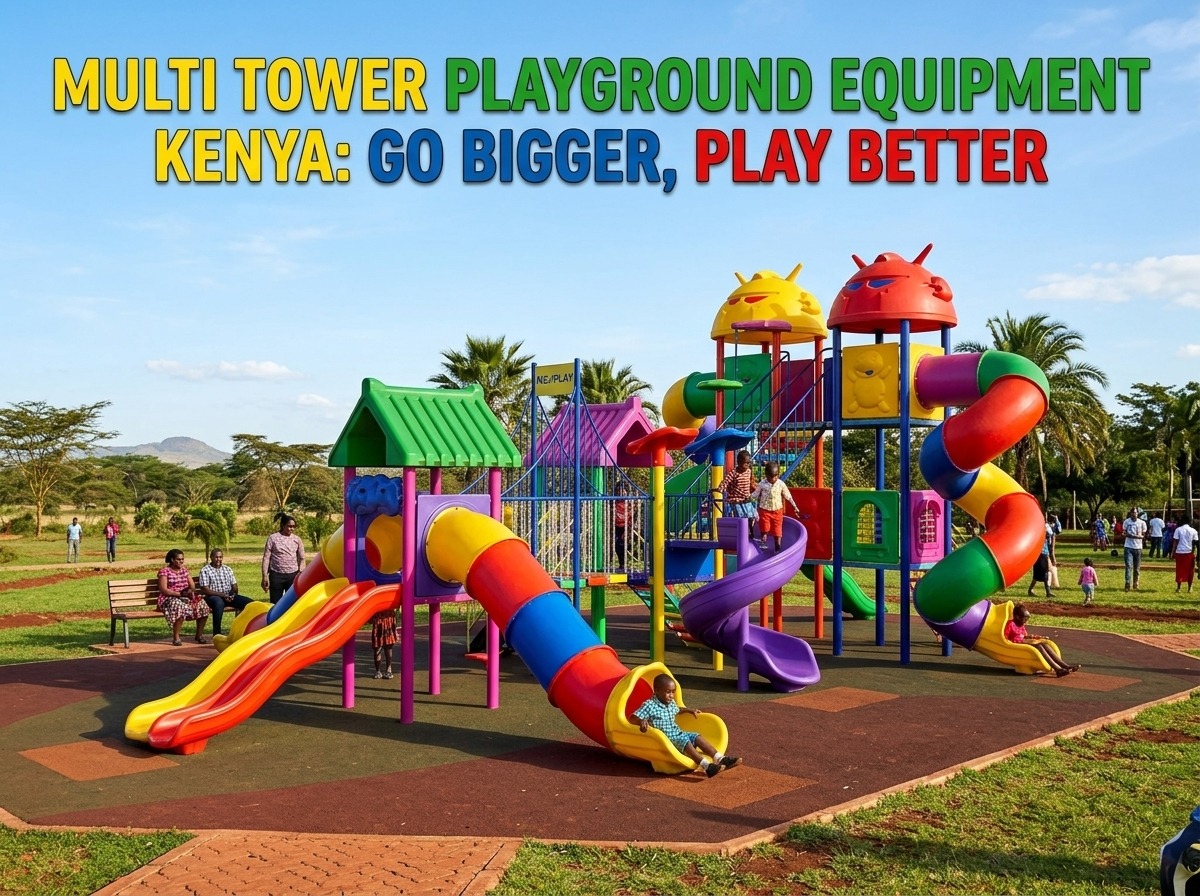
Playgrounds across Kenya tend to run into the same issue: they’re in constant use, but they’re overcrowded, harder to supervise than they should be, and too small for the number of children relying on them. That’s where multi tower playground equipment becomes a practical solution rather than a luxury.
It’s not about appearance, but about scale and choosing the right playground equipment for the environment—whether in a Nairobi park, a large school, or a residential estate.
Most schools start with a single or double-tower system then later upgrade to a three-tower structure when they realise they have a capacity problem. Multi-tower systems have four, five, or more connected towers forming one large, integrated play environment.
The difference isn’t just size. It’s what the size enables. More towers mean more simultaneous activity zones, more entry and exit points, and a genuinely dispersed crowd of children rather than a queue at one slide.
Multi tower playground equipment is commercial grade by definition. It’s built for high-traffic environments where hundreds of children use the structure every day, across multiple sessions, in conditions that would degrade lighter equipment quickly.
Public parks, large primary schools, recreational spaces, and high-density residential estates are the natural settings. If your site regularly sees more than 100 children at once, this is the category to be looking at.
Mega Playground Systems for Public Parks — Why Size Matters Here
A public park has a different challenge from a school. Children arrive unpredictably throughout the day. Ages range from toddlers to teenagers. There’s no teacher directing traffic.
A small structure in a busy public park can quickly turn into a conflict zone. Older children dominate the equipment while younger children get pushed out. And instead of taking the time to relax, parents and guardians spend their visit intervening.
Mega playground systems for public parks solve this by creating enough activity zones that children naturally self-sort. The toddler doesn’t need the high climbing wall. The older child isn’t interested in the low activity panel. The layout distributes the crowd without anyone managing it.
Park systems need to be visually striking as well as functional. A well-designed large playground draws families to a park — it’s one of the primary reasons people choose one public space over another.
Durability requirements are also different. A school playground is supervised and locked at weekends. A public park playground runs seven days a week, exposed to full weather, with no overnight closure. Materials need to be rated for that.
Polyplay Ppl B 01 Mega Station — The Entry Point to Large-Scale Play
The Polyplay Ppl B 01 Mega Station is Polyplay’s entry into the B-series — the larger multi-tower range designed for high-capacity environments.
The B-series sits above the 3-tower Ppl 3T range. These are structures built for sites where a three-tower system is the right type of equipment but not the right scale.
The Ppl B 01 gives buyers the interconnected multi-tower format — multiple platforms, varied activity types, open sightlines — in a configuration suited to large primary schools and mid-sized public parks. It’s the step up that makes sense when you know a smaller system will be overwhelmed within months of installation.
For schools or parks making their first move into multi-tower systems, the Ppl B 01 is the practical starting point. It handles genuine volume without the footprint or budget of the largest systems in the range.
The Polyplay Play Station Ppl B 06 is one of Polyplay’s largest multi-tower configurations — designed for county parks, large school campuses, and public recreational spaces where capacity is the primary specification.
At this scale, the number of simultaneous users the structure can handle goes up significantly. More towers mean more slides, more climbing routes, more activity panels, and more children engaged at once without any section becoming congested.
The B 06 is the system worth buying when the site is genuinely large and the expected daily usage is genuinely high. Not every school or park needs this scale. But the ones that do tend to find that anything smaller is visibly inadequate within their first busy break time.
All Polyplay B-series systems use UV-stabilised plastics throughout, with corrosion-resistant steel framework. A large system with inadequate materials will show degradation faster than a small one because there’s simply more surface area exposed to Kenyan sun, rain, and dust.
Choosing Between the B 01 and B 06 — A Practical Guide
The honest question to ask before specifying either system is how many children will use the equipment simultaneously at peak time.
A site with 150 children at peak has different requirements from a site with 400. Both might need multi-tower equipment. Only one needs the B 06.
Larger systems need larger fall zones. The clearance requirement around any multi-tower structure extends at least two metres beyond the outermost point in every direction. On a constrained site, the B 01 may be the right answer even if budget allows for the B 06.
Polyplay’s team conducts site assessments before any installation is confirmed. This isn’t a formality — it’s how the right system gets matched to the right site. Specifying a structure that’s too large for a site is as much of a problem as specifying one that’s too small.
For the wider context on safety standards and what commercial playground equipment needs to meet, IPEMA (International Play Equipment Manufacturers Association) certifies equipment against independently tested public-use safety requirements. It’s worth understanding what those standards cover before any large-scale purchase.
Multi tower playground equipment solves the outdoor play problem. But the environment children spend most of their school day in (the classroom) also matters.
If you’re planning a full school upgrade across both outdoor and indoor spaces, the Polyplay school furniture guide covers what to specify for classrooms. And for the outdoor play planning process more broadly, the playground equipment for schools Kenya guide covers capacity calculations, safety surfacing, and installation requirements.
The Polyplay Play Station Ppl 3T 12 is also worth comparing directly — it’s the three-tower system that sits just below the B series, and understanding the difference helps clarify which scale is right for your site.
What is the difference between the Ppl 3T range and the B series?
The Ppl 3T range covers three-tower systems. The B series — including the Ppl B 01 Mega Station and Polyplay Play Station Ppl B 06 — is for larger, higher-capacity environments where a three-tower system would be undersized. The B series handles significantly more simultaneous users and suits larger sites.
Is multi tower playground equipment suitable for a county public park?
Yes — it’s one of the primary use cases. Large public parks need systems that handle unpredictable visitor volume across mixed age groups without any one section becoming congested. Mega playground systems for public parks are designed exactly for this.
How much space does a B-series system require?
It depends on the specific configuration. All multi-tower systems require meaningful fall zones extending at least two metres beyond the structure in every direction. Polyplay conducts site assessments to confirm exact requirements before installation.
What maintenance does a large multi-tower system need?
Monthly visual inspections for loose fixings, worn components, and surface damage. UV-stabilised materials reduce maintenance significantly compared to unprotected equipment. Polyplay can advise on an inspection schedule appropriate for your site’s usage volume.