

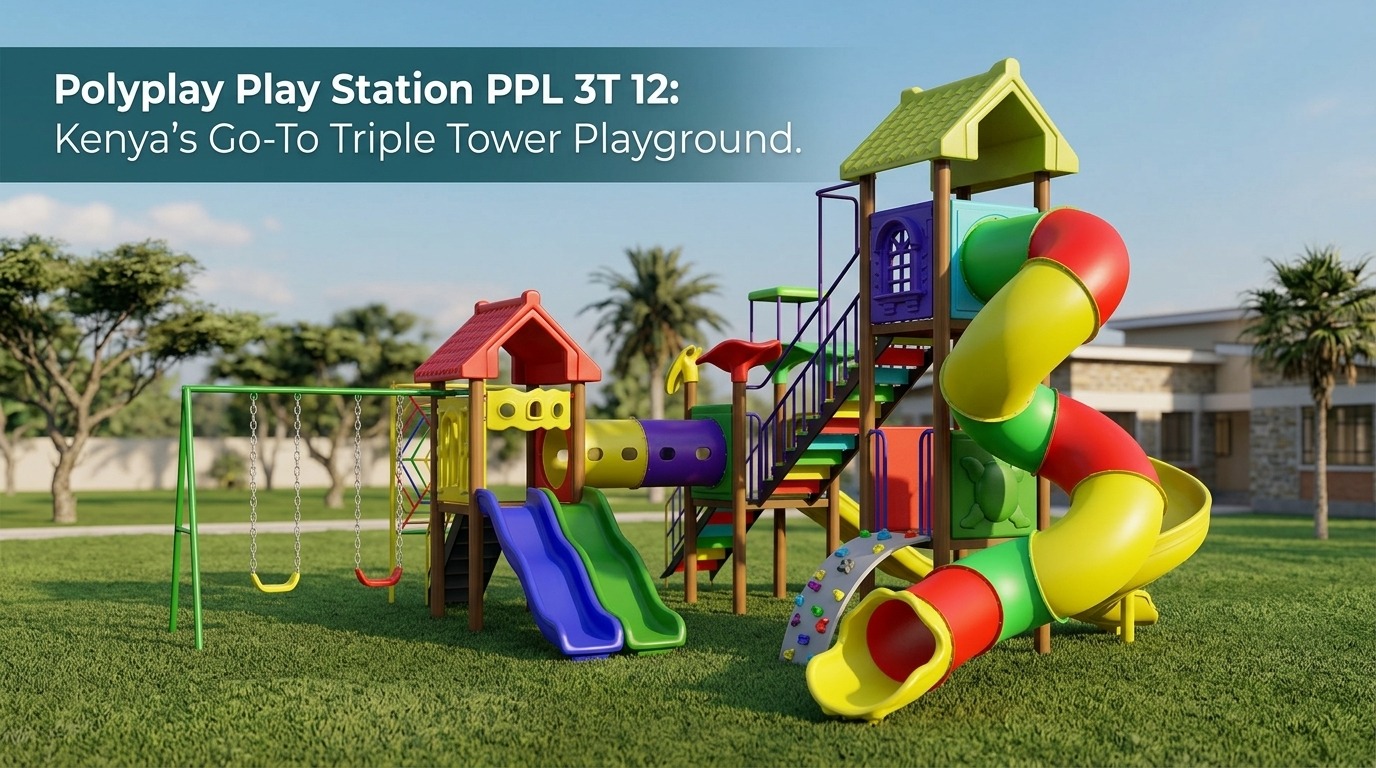
If you’ve ever watched 40 children pile onto a playground at the same time, you know how fast a small structure gets overwhelmed. Children queue. Tempers flare. Teachers spend more time managing traffic than supervising play.
That’s exactly the problem the Polyplay Play Station Ppl 3T 12 is built to solve. Not just giving children somewhere to play — but giving enough children somewhere to play, at the same time, without the chaos.
This is a large 3 tower playground system. Three connected platforms, twelve activity zones, and enough entry and exit points that children naturally spread out rather than pile onto one slide. Schools across Kenya have noticed the difference. So have the parks and housing estates that installed one and watched it become the most-used corner of their entire site.
The Ppl 3T 12 is Polyplay’s triple tower playground — three distinct platforms linked together into one integrated structure.
The “12” is the activity count. Twelve play elements spread across the system: slides, climbing walls, bridges, activity panels, and connecting walkways. Not twelve versions of the same thing — twelve different things, designed for different ages and different play styles.
This is 3 tower playground equipment built for volume. Not a residential structure scaled up to fit a school. A commercial-grade system rated for heavy, sustained use by large groups of children — which is precisely what Kenyan schools, parks, and estates need.
One tower creates a bottleneck. Every child wants the slide, so they all queue at the same ladder. The slide becomes the whole playground, and everything else is ignored.
A 3 Tower Play Station for Parks solves this structurally. With three towers and twelve activities, children spread out on their own. Some head to the climbing wall. Others cross the bridge to the middle section. A few stay at the activity panel for ten minutes. No teacher has to manage the traffic — the layout does it.
For a school with 200 children on break at once, that difference is significant.
For a public park where children of mixed ages arrive throughout the day, it’s the difference between equipment that works and equipment that frustrates both children and the adults watching them.
Built for Kenya’s Conditions — Not Just for Kenya’s Budget
Cheap playground equipment doesn’t last in Kenya. That’s not opinion — it’s what happens when you put unprotected materials through intense equatorial sun, heavy rain seasons, red dust, and constant use by energetic children.
Frames rust. Plastics crack and fade. Joints loosen and become hazards.
The Polyplay Play Station Ppl 3T 12 uses UV-stabilised plastics across all components. Not general-purpose plastics that happen to be colourful — materials specifically rated for tropical sun exposure.
The steel framework has corrosion-resistance treatment throughout. Schools that have installed this system report years of regular use without significant structural degradation.
That matters when you’re making a capital purchase that the budget committee will ask about for the next decade.
A 3 Tower Play Station for Parks needs to handle children of mixed ages arriving in unpredictable numbers. Twelve activities across three towers means there’s always something available regardless of how busy it gets.
Younger children gravitate towards lower platform activities. Older children go straight for the climbing wall and the highest slide. The structure handles mixed age groups naturally, without needing separate fenced zones.
The value is in break-time efficiency. A 30-minute break goes fast when children spend half of it queuing. A large 3 tower playground system handles the rush.
Multiple children use the structure simultaneously without conflict. Teachers supervise more easily because the layout is open and spread across a defined area.
The installation becomes a feature. Families choose estates partly based on communal spaces. A triple tower playground visible from the road communicates something specific about the development standard — functional, yes, but also a real draw for families with children.
Typically two or three across the system, covering different heights. A younger child on a lower slide doesn’t feel excluded. An older child isn’t bored because the upper platform is genuinely challenging to reach.
These aren’t token additions. Children return to them repeatedly because they present a real challenge — not too easy, not too dangerous. Getting to the top is an achievement a child remembers.
The interconnected layout creates natural movement flow between towers. There’s always somewhere to go next, which keeps children active longer without them realising it.
Spinners, puzzles, and interactive panels give children who aren’t climbing something to engage with. Particularly good for more cautious children who still want to be part of the action without the height.
Installation, Safety Standards, and Site Preparation
Large 3 tower playground systems need proper space and proper ground preparation.
The Ppl 3T 12 has specific footprint dimensions. Measure carefully and account for required fall zones around the full perimeter. Safety surfacing — rubber matting, wood chips, or impact-absorbing material — is required under and at least two metres beyond the structure in every direction. Bare concrete or compressed soil is not sufficient.
On safety specifications: commercial playground equipment is assessed against standards set by bodies like IPEMA (International Play Equipment Manufacturers Association), which certifies equipment against independently tested safety requirements for public use.
When buying for a Kenyan school or park, it’s worth asking suppliers whether their products are built to internationally recognised specifications — not just what looks appealing in a brochure.
Polyplay handles installation as part of the package. Incorrect installation of a multi-tower system creates structural instability over time. Getting it right at installation is far cheaper than correcting problems later.
Planning a Full School Environment?
The playground is one part of the picture.
If you’re upgrading a school and want both the outdoor and indoor environments covered properly, Polyplay supplies the full range. The furniture that goes inside the classroom — durable classroom chairs and tables built for Kenyan conditions — is covered in detail in Polyplay’s school furniture guide. It’s worth reading alongside this if you’re planning a broader school fit-out.
What age range is the Polyplay Play Station Ppl 3T 12 designed for?
The Ppl 3T 12 is designed for children aged 3 to 12. Lower-height activities suit younger children; the climbing walls and upper slides are pitched at older children. It handles mixed age groups well without needing separate equipment zones.
How much space does the 3T 12 require?
Large 3 tower playground systems require meaningful clearance around the structure for fall zones and safety surfacing. Polyplay’s team can advise on exact dimensions and conduct a site assessment before installation is confirmed.
Is this suitable for a public park in Kenya?
Yes. The Ppl 3T 12 is rated for commercial use and is one of Polyplay’s primary recommendations for parks. The multi-tower layout handles high visitor volume far better than smaller structures, and the materials are specified for Kenyan outdoor conditions.
How long does installation take?
Typically one to three days depending on site preparation and ground conditions. Polyplay’s installation team handles the full process.
What maintenance does the Ppl 3T 12 need?
Regular checks for loose fixings, wear on moving parts, and surface damage. UV-stabilised components reduce the maintenance burden significantly compared to unprotected equipment. Polyplay can advise on an appropriate inspection schedule for your usage volume.
Ready to see the Polyplay Play Station Ppl 3T 12 in detail or get a quote for your site? Visit polyplay.co.ke or call the team directly.