

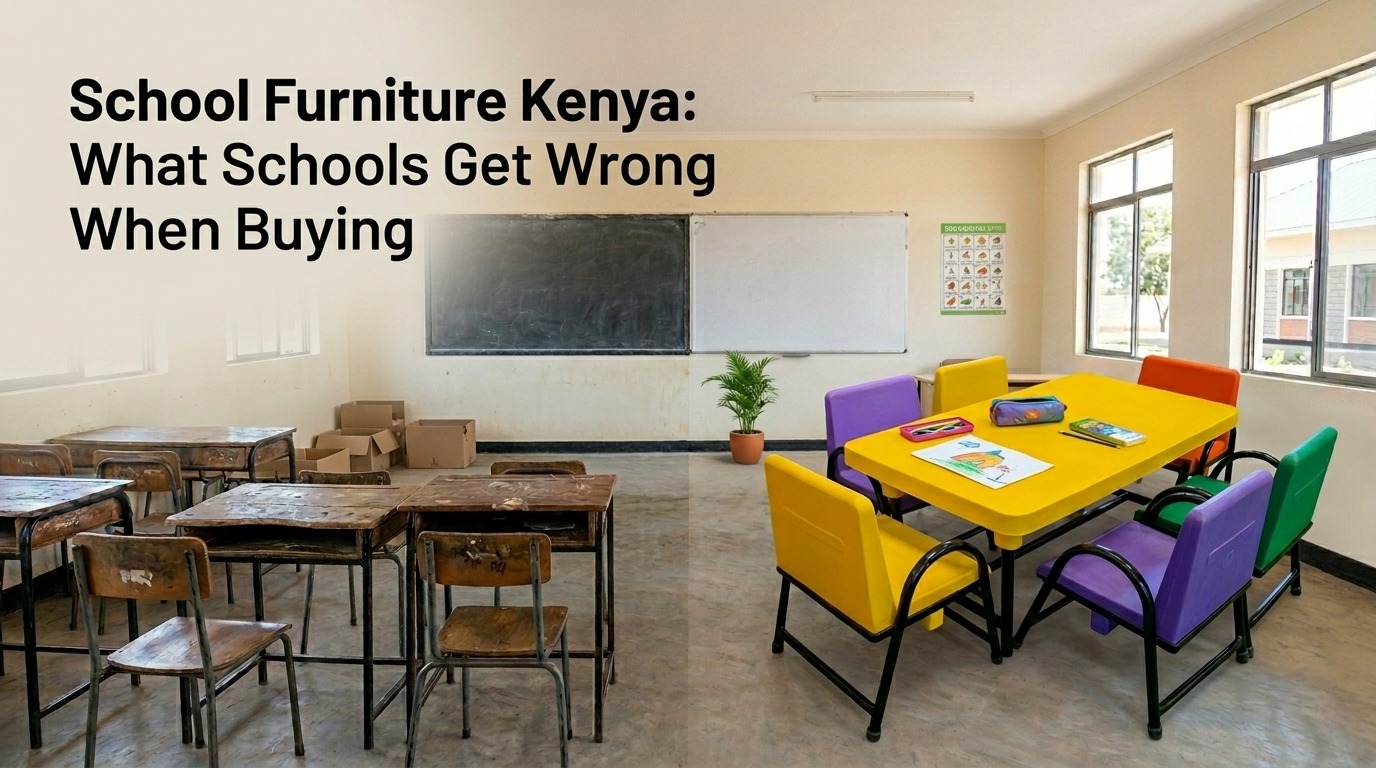
I’ve seen it happen in at least three schools in Nairobi. They buy the cheapest school furniture Kenya has available, get three years out of it, replace the lot, then buy cheap again.
By year six they’ve spent more than quality furniture would have cost in the first place. And the classrooms looked worse for most of those six years — wobbling chairs, cracked seats, desks that couldn’t survive a protractor left on them overnight.
The problem isn’t budget. It’s the question being asked. Most procurement decisions start with “what’s the lowest price per unit?” when the right question is “what does this cost us per year, across its actual lifespan?”
Children in Kenyan schools spend the better part of their day sitting down. Research in ergonomics literature found that pupils spend around 92% of classroom time in static sitting positions.
That statistic should change how you think about furniture. A chair and desk are not background infrastructure. They’re the environment a child lives in for six or seven hours a day, five days a week, for years.
When that environment is wrong — chairs too high, desks too low, seats that offer no back support — children fidget, slouch, and lose concentration faster.
A review published in the journal Ergonomics found that ill-fitted classroom furniture is directly linked to reduced on-task behaviour and increased physical discomfort in school-age children. That’s the reason some classes are harder to manage than others, and nobody thinks to check the chairs.
Good school furniture doesn’t solve everything. But bad furniture quietly makes everything harder.
Young children are not small adults. Their proportions are completely different — shorter legs relative to their trunk, different balance points, narrower shoulders.
Furniture designed generically for “children” rather than specifically for 3 to 6-year-olds will be wrong in ways that aren’t immediately obvious. The table height won’t match the seated child’s elbow height. The chair seat will be too deep, pushing the child into a slumped position.
The most common mistake with kindergarten furniture Nairobi schools buy is height. A table too tall forces a young child to raise their arms constantly, which is tiring and affects writing and drawing ability.
A chair too deep means the child’s legs don’t reach the floor — they perch and slump for hours. Neither looks dramatic. Both are there every single day.
Fibre-glass-coated tops on metal frames are the most practical combination for Kenyan kindergartens.
Wood warps with humidity and splits along the grain over time. Bare metal is cold and inappropriate for young children. The hybrid construction — steel frame, coated top — handles daily use, juice spills, paint, and repeated cleaning without degrading.
Bright colours also matter. Not just for aesthetics — early childhood learning responds to warm, colourful environments in ways that an institutional beige room simply doesn’t.
Hexagonal and trapezoid tables are worth considering over standard rectangles. They seat children facing each other, which supports the collaborative, activity-based learning that early years education works best with.
A room full of rectangular tables defaults to rows-facing-front. That’s the wrong format for a nursery or reception class.
Durable classroom chairs and tables for Kenyan primary schools need square-tube steel frames, not round tubes.
Square tube resists lateral force better — it doesn’t twist when a child repeatedly tips a chair in one direction. The gauge of the steel matters: a thicker gauge takes longer to bend and longer to corrode.
Ask suppliers about gauge specifically. “Steel frame” covers a very wide range of quality.
Seat material should be solid enough not to crack when a heavier child sits down hard. Thin injection-moulded plastic that flexes visibly will crack within two years in a busy school.
Desk surfaces should be Formica or blockboard-topped. These resist scratching and marking far better than raw wood, which dents, stains, and eventually splinters under daily use.
A chair sized for a Standard 1 pupil is genuinely wrong for a Standard 7 pupil. The height difference between a 6-year-old and a 13-year-old is significant.
Schools that buy one size for the entire primary range end up with older children folded into chairs too small for them or younger children lost in chairs sized for adults. Neither is comfortable. Both affect concentration.
The fix is buying in two size ranges — lower primary and upper primary — even if this has to be phased across budget cycles.
The 3-seater bench for schools is the most common piece of furniture in Kenyan classrooms for a reason. Three children at a shared bench with an attached writing surface take up less floor space than three individual desks and chairs.
In classrooms that are overcrowded — which describes most Kenyan primary schools — that space-saving is real and worth something.
A bench means three children are fixed in the same position relative to each other and the surface. If the height doesn’t suit one of them, none of them can adjust.
If you want to rearrange the room for group work or a different activity, benches are significantly harder to move than individual chairs. For traditional teaching — teacher at the front, children facing forward — benches work well. For schools moving towards activity-based learning, individual seating gives teachers flexibility that benches don’t.
This isn’t a verdict against benches. It’s worth knowing which teaching format your school actually uses before committing the whole classroom to one layout.
Kenyan classrooms face conditions that accelerate furniture wear significantly.
Intense UV exposure from the equatorial sun makes unprotected plastics brittle and cracked within a few years. Metal frames without proper rust-proofing — particularly in coastal schools near Mombasa — show surface corrosion within months. Even inland schools in Kisumu and Nakuru deal with humidity levels that attack unprotected frames faster than most product specifications account for.
Before signing any purchase order for school furniture Kenya schools will use long-term, ask these three questions:
Are the plastic components UV-stabilised? What is the steel gauge and what rust treatment is applied to the frames? What surface coating is on the desk tops, and is it waterproof?
Generic answers mean generic quality. Suppliers who can answer these specifically have thought about what Kenyan conditions actually do to furniture over time.
A school that buys at KSh 3,000 per desk-chair set and replaces after three years spends KSh 1,000 per unit per year.
A school that pays KSh 7,000 per unit and gets ten years from it spends KSh 700 per unit per year.
The cheaper furniture is the more expensive option. This isn’t a complicated calculation — it’s just not the calculation most procurement committees run.
Schools that have been through the replacement cycle more than once tend to change how they frame the question. Instead of “what is the cost per unit?” they ask “what is the cost per unit per year based on realistic lifespan?” That single change shifts almost every furniture decision.
The classroom is one part of a child’s school day. Break time is another, and what children do with it – whether they have proper outdoor space and proper equipment – affects how settled they are when they come back inside.
Schools that invest in good indoor furniture while neglecting outdoor play are solving half the problem.
Polyplay supplies both. The Polyplay Play Station Ppl 3T 12 is the outdoor system worth looking at alongside the furniture range — a triple tower playground built for the volume and climate conditions Kenyan schools deal with every day.
And if you’re also thinking about how to set up outdoor play areas from scratch for younger children, the Polyplay guide to creating an outdoor play area for kids covers the full planning process.
Should I buy a 3-seater bench or individual chairs and desks?
It depends on how the classroom is actually used. A 3-seater bench for schools is more space-efficient and works well in traditional teaching formats. Individual chairs give teachers flexibility to rearrange the room for group activities. If your school uses a fixed, teacher-led format, benches are a sensible choice. If the teaching approach changes regularly, individual seating is worth the extra cost per unit.
Does furniture size matter if children are different heights?
Yes — and it’s the most overlooked issue in school furniture procurement across Kenya. A chair sized for a 7-year-old is wrong for a 13-year-old. Buying one size for the whole primary school is the most common mistake Kenyan schools make. The fix is two size ranges: one for lower primary and one for upper primary, phased in gradually if the budget requires it.
How long should quality school furniture last in Kenya?
Well-specified furniture — correct gauge steel, UV-stabilised plastics, proper rust treatment — should last eight to twelve years under normal daily use. Budget furniture often needs replacement within three to five years. Asking suppliers about expected lifespan under Kenyan conditions gives far more useful information than comparing purchase price alone.
Where can I get school furniture supplied across Kenya?
Polyplay supplies durable classroom chairs and tables and kindergarten furniture across Kenya. Visit polyplay.co.ke for the current range or contact the team directly for a procurement quote.