

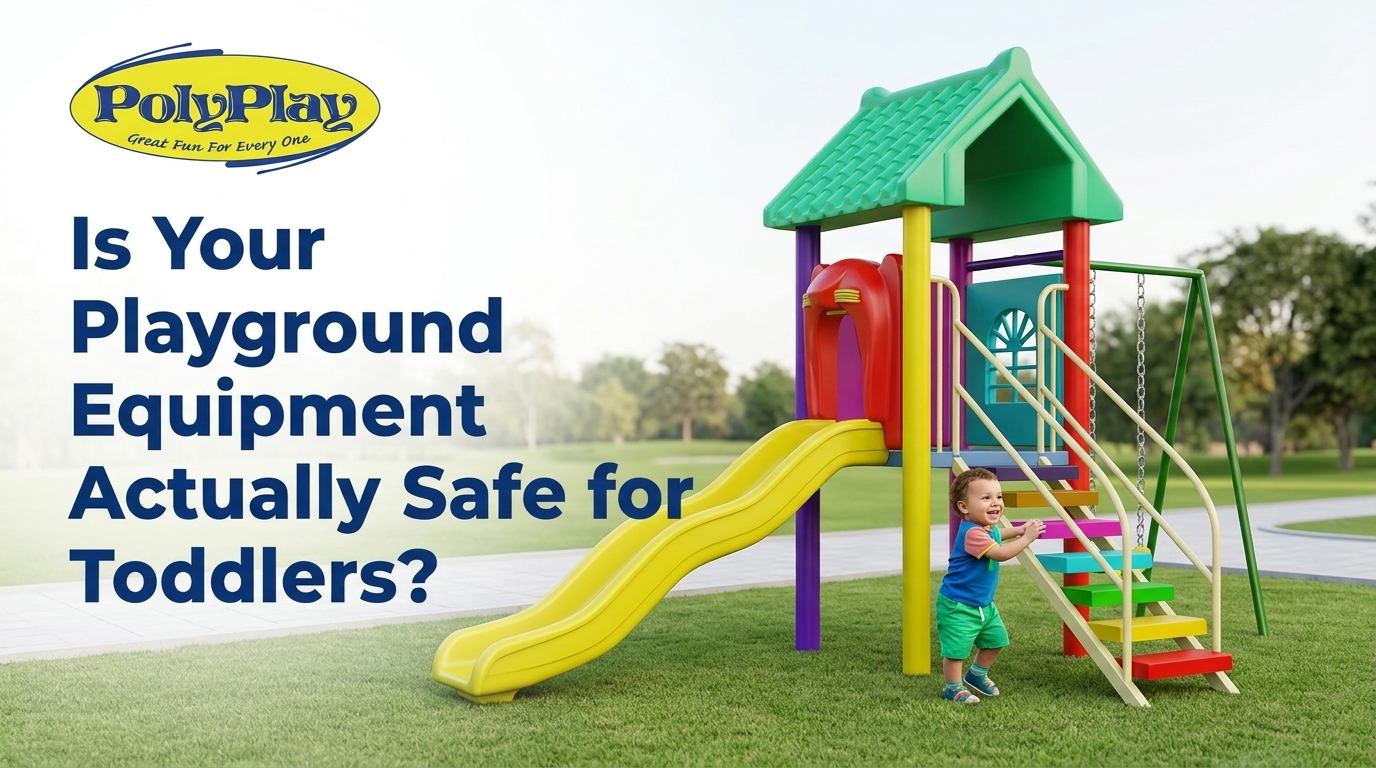
A toddler’s first time on a playground tells you everything. They run straight for whatever looks exciting — the tall slide, the wobbly bridge, the highest platform. No filter for danger. That’s not recklessness, that’s just how small children explore the world.
The problem is that a lot of playground equipment in Kenya isn’t designed with that reality in mind. It’s designed to look good in a brochure.
If you’re a parent, school administrator, or estate manager choosing equipment for children under five, the question isn’t whether it looks fun. The question is whether it was actually built for toddlers — their size, their coordination, their unpredictability.
Age-appropriate design is the first thing to check, and most buyers miss it. There’s a real difference between equipment for three-year-olds and equipment for seven-year-olds. Platform heights, handrail spacing, slide gradients, step depth — these all change depending on the child’s size and motor development.
For toddlers, platforms should sit no higher than 50–60cm. Steps need to be shallow enough for short legs. Handrails must be within reach, not positioned for an older child’s grip height. If the equipment doesn’t specify an age range clearly, that’s already a problem.
The surface underneath matters just as much as the structure itself. A child falling from 60cm onto hard compacted soil is still at risk. Rubber safety surfacing reduces that risk significantly — factor it into the budget at the planning stage, not as an afterthought.
Toddlers don’t just play on equipment. They touch it constantly, put hands near their mouths, sit on it in the heat. The materials used in construction have a direct effect on the children using it.
Low-quality plastics degrade quickly under Kenya’s equatorial sun. They crack, splinter, and in some cases aren’t safe for prolonged skin contact. Eco-friendly playground equipment uses UV-stabilised, non-toxic plastics and treated timber that hold up without becoming hazards over time.
The durability argument runs the same way. Equipment built with better base compounds lasts longer, maintains structural integrity under heavy use, and doesn’t degrade into sharp edges or unstable joints. Spending more upfront is cheaper over five years than replacing budget equipment twice.
The specification sheet tells you what the manufacturer chose to measure. It doesn’t always tell you what you need to know.
Ask for the intended age range of every piece. Ask whether the plastics are UV stabilised. Ask whether the steel framework is galvanised — in Kenya’s climate, untreated steel corrodes faster than most suppliers will admit upfront.
For toddler equipment specifically, check that there are no gaps between 9mm and 23mm anywhere in the structure. That’s the range where small fingers and toes get trapped. It’s one of the most common causes of minor playground injuries, and one of the easiest things to eliminate with proper design.
Toddlers don’t need large, complex structures. A low platform, a wide slide, a sensory panel, and a small climbing section gives everything a child under five needs developmentally — coordination, grip strength, spatial awareness, social confidence. All of it happens in a modest, well-specified space.
What they don’t need is equipment that groups them with older children. That’s where injuries actually happen. Not because toddlers are fragile, but because mixed-age dynamics consistently put younger children in situations they’re not ready for.
The EN 1176 standard covers structural integrity, entrapment hazards, fall heights, and surface requirements. It’s not a legal requirement everywhere, but any supplier who can’t confirm their equipment meets it is not worth the risk.
The right playground equipment for toddlers is specific, not generic. It’s designed for their height, their grip, their tendency to fall sideways without warning. It’s built from materials that don’t deteriorate into hazards, above a surface that actually cushions a fall.
None of that requires an enormous budget. It requires asking the right questions before the purchase, not after. If you’re looking for age-appropriate, eco-friendly playground equipment in Kenya, start by comparing options built for real Kenyan conditions — not adapted from a catalogue designed for somewhere else.
Typically 18 months to 4 years. This group needs lower platforms, shallower steps, and closer handrail spacing than equipment built for older children. Always check the manufacturer’s stated age range.
In most cases, more durable. UV-stabilised plastics and treated structural materials hold up better under Kenya’s climate than cheaper alternatives.
EN 1176 is the European standard most widely referenced in Kenya’s commercial playground market. Ask any supplier to confirm compliance before purchasing.