

I’ve watched so many schools and nurseries get this wrong, honestly. They order brilliant playground equipment, everyone’s excited about it arriving, then they realise it won’t actually fit in the space they’ve got. Awkward conversations with suppliers follow. I’ve been on both sides of those phone calls, and they’re never fun.
Let me walk you through exactly what space you need for 2 tower playground equipment, including all the bits people forget about until it’s too late. I’ll share some measurements I’ve learned through actual installations rather than just what brochures tell you.
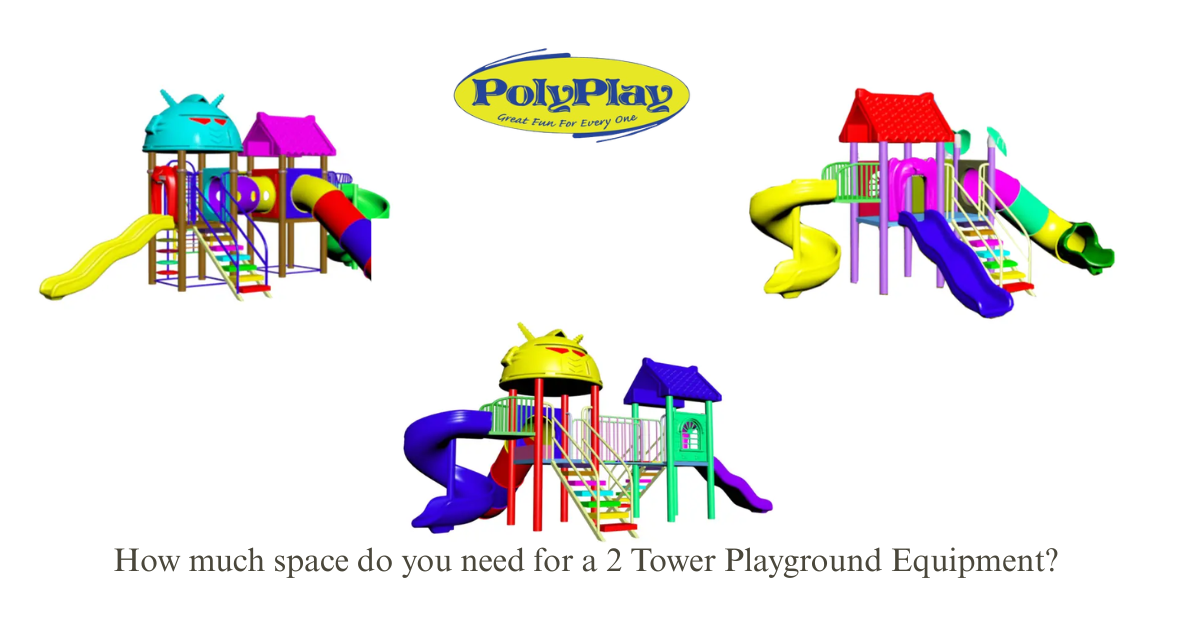
Right, so the equipment itself typically measures around 6 to 8 metres long by 3 to 4 metres wide. That’s just the physical structure. I’ve seen people measure exactly this space, order the equipment, then act shocked when it doesn’t work. The structure is only part of what you need to plan for.
Double tower playground equipment configurations vary depending on features. A basic setup with two towers, a connecting bridge, and a couple of slides needs less space than one loaded with climbing walls, multiple slides, and monkey bars. The more features you add, the more ground you’re covering.
Here’s where most calculations go wrong. You need impact zones around every piece of equipment. These aren’t suggestions, they’re safety requirements. A child falling from a slide or jumping off monkey bars needs clear space to land safely.
The minimum impact zone is typically 2 metres from any point where children could fall. Your slide exit? Add 2 metres beyond where the kids land. Swing path? Clear space front and back. Climbing elements? Safety zone all around. Suddenly, your 6-metre structure needs 10 metres of total space.
I’ve seen playgrounds fail safety inspections because they squeezed equipment into spaces without proper impact zones. The playground looks fine until an inspector measures clearances and finds you’re 50 centimetres short somewhere. Then everything needs relocating, or you remove features. Neither option is cheap.
Proper calculation: Take your equipment dimensions, add 2 metres on all sides for impact zones. That’s your actual space requirement. So that 6-metre-long structure? You need a minimum of 10 metres. The 4-metre width becomes 8 metres. Your total area goes from 24 square metres to 80 square metres—a big difference.
Safety surfacing takes up more space than you’d think. It needs to extend beyond the equipment structure into those impact zones. You can’t just put rubber matting directly under the equipment and call it done. The surfacing must cover anywhere children could land.
Wetpour rubber surfacing typically extends at least 1.5 to 2 metres beyond equipment edges. Rubber tiles or mulch need similar coverage. Different surfaces need different preparation depths, too. Wetpour goes over existing concrete or tarmac fairly easily. Loose-fill materials like bark mulch need proper edging and depth. Grass matting requires level ground. Your space calculation needs to account for surface preparation work, not just the finished surface area.
Children actually need to reach the playground equipment. I’ve seen playgrounds installed with brilliant equipment that’s awkward to access because nobody planned circulation routes. Kids end up walking across planted areas or creating mud paths through grass because there’s no proper access.
Pathways to playground equipment should be at least 1.5 metres wide for comfortable two-way traffic. Wider if you need wheelchair access, which you should be planning for anyway. These paths add to your total space requirement but make the playground actually functional rather than just theoretically brilliant.
Supervision sightlines matter too. Teachers or parents need to see all parts of the playground from wherever they’re positioned. This might mean keeping certain areas clear that you’d otherwise think could hold equipment. A playground you can’t supervise properly isn’t safe, regardless of how much space the equipment technically fits into.
When planning 2 tower play station for schools, you need to think about capacity. How many children will use it simultaneously? A nursery with 20 children has different space needs than a primary school with 300 students.
Queuing space becomes important in larger schools. During break times, children wait for turns on popular equipment. They need somewhere to queue that doesn’t block access or create safety issues. I’ve watched playgrounds turn chaotic because there’s equipment, but nowhere for children to wait their turn safely.
Age group matters significantly. Equipment sized for 5-year-olds needs less space than equipment for 10-year-olds. Older children run faster, jump further, and need larger impact zones. A two-tower playground for upper primary students requires considerably more space than an identical structure for nursery children.
Some schools need to separate age groups completely. You might need space for two different two-tower setups, one for younger children and one for older students. This obviously doubles your space requirement. Planning for current enrolment without considering future growth is shortsighted, too. Schools grow, and playground equipment is expensive to relocate.
Polyplay 2 tower playground price depends partly on space requirements. Larger footprints need more safety surfacing, more groundwork preparation, and potentially more installation labour. A compact design that fits a tight space costs differently than a sprawling layout.
Site preparation can exceed equipment costs if your space has issues. Uneven ground needs levelling. Poor drainage requires fixing before equipment installation. Rocky soil makes foundation work expensive. I’ve seen quotes double once site conditions were properly assessed rather than assumed.
Access for installation vehicles matters too. Can a lorry actually reach your playground area? Or will equipment need to be hand-carried across your site? I know a school where equipment had to be lifted over a fence because there was no vehicle access to the playground. That added thousands to installation costs.
Durable 2-tower play stations need maintenance access. You can’t cram equipment so tightly into a space that nobody can inspect or repair it properly. Leave room to actually reach all parts of the structure for annual safety inspections and routine maintenance.
Weather affects how much space equipment needs over time—surfacing materials compact or shift. Grass around equipment wears away from constant foot traffic, creating mud patches that spread. That pristine installation gradually expands its footprint as children create desire paths and wear patterns.
Some schools border equipment with planted areas to save space. This works initially but creates maintenance headaches. Plants need tending, which means people walking through playground areas with tools and equipment. Children often damage plants while playing near them. Better to plan adequate hard surfacing from the start rather than trying to squeeze in gardens that’ll get destroyed.
Measure at ground level where the equipment will actually sit, not where you’re standing. I’ve watched people measure playground spaces from elevated positions and get dimensions wrong because of perspective. Walk the actual area with a long tape measure.
Mark out the proposed equipment area with stakes and string before ordering anything. Live with these markers for a week or two. Watch how children use the space currently. See if your planned layout blocks important sight lines or access routes. Better to discover problems whilst markers are cheap string rather than after expensive equipment arrives.
Account for underground services. Water pipes, electrical cables and drainage systems all affect where you can install equipment foundations. Hitting a water main during installation is expensive and disruptive. Most suppliers can arrange service location surveys if you’re unsure what’s underground.
Overhead clearance matters too. Trees, power lines and building overhangs all limit how tall equipment can be. Your horizontal space might be perfect, but if there’s a tree branch 2 metres up, you can’t install a 3-metre slide. Check vertical clearances as carefully as horizontal measurements.
Polyplay provides site surveys before installation. They’ll measure your space, assess conditions, and recommend equipment that actually fits rather than just what you think looks good. This service saves schools from expensive mistakes. Their team has installed hundreds of playgrounds across Kenya.
👉 Visit Polyplay to explore 2 tower playground options and arrange a site survey for professional space assessment and equipment recommendations.

