

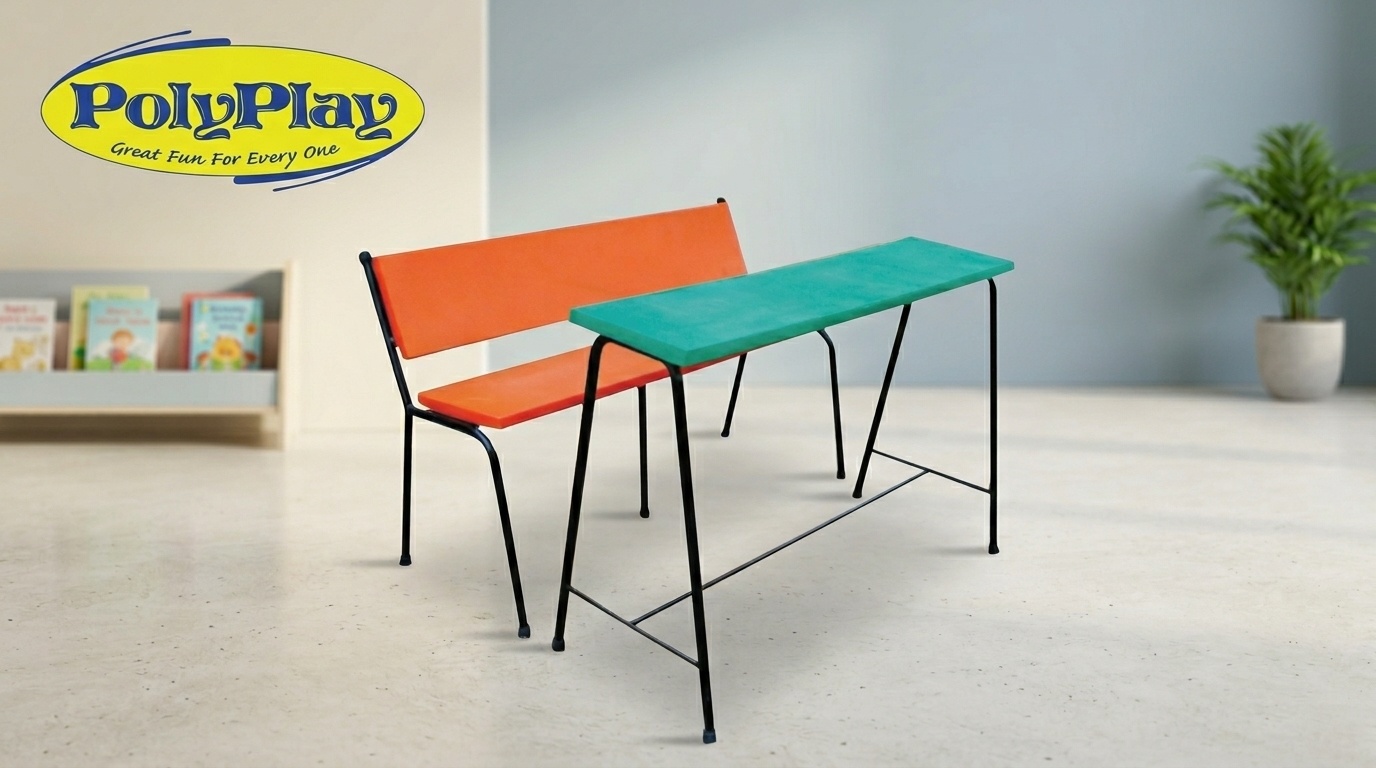
Walk into most Kenyan classrooms and the same problem repeats itself. Children hunched over tables that are too tall. Chairs so deep the child’s legs dangle. A three-seater bench being shared by four children because the school bought too few. The school furniture is there — it’s just not doing the job it was bought to do.
Getting this right isn’t complicated. But it does require asking different questions before the purchase order goes through.
This is the single most common mistake with school furniture procurement in Kenya, and it shows up at every level — nursery, primary, and secondary.
For kindergarten furniture in Nairobi, the correct seated-table height for a child aged three to five is roughly 46–52 cm. The chair seat height should be at about 26–30 cm, allowing both feet to rest flat on the floor. When those numbers are off — even by 5–6cm — children can’t sit comfortably for any length of time. They fidget and lose focus, and their posture suffers over years of daily use.
Most suppliers don’t state these dimensions clearly. They list the product as “kindergarten size” and leave the buyer to assume. Before confirming any order, ask for the exact table height and seat height in centimetres. If a supplier can’t provide those figures, that’s a problem worth taking seriously.
Durable classroom chairs and tables in Kenya need to survive a specific combination: intense sun, humidity, daily impact from children, repeated cleaning, and a budget that doesn’t allow for replacement every two years.
The most reliable frame material is square-tube steel, not round tubes. Square-tube frames resist lateral flex — the wobble that develops over time when chairs are scraped across floors and stacked daily. Round-tube frames look similar but degrade faster under the same conditions.
For the table surface, fibre-glass-coated tops on a metal frame outperform both bare wood and plain metal. Solid wood warps with humidity changes — a real issue in Kenya’s varied climate from Nairobi to Mombasa. Bare metal is cold and inappropriate for young children. The hybrid construction handles paint, juice spills, and daily cleaning without degrading or lifting at the edges.
Colour matters too, particularly for early years. Bright, warm colours in a kindergarten classroom support the active, collaborative environment that learning at that age requires. An institutional beige room is the wrong environment for a three-year-old.
The 3-seater bench for schools is the most space-efficient option for Kenyan primary classrooms, and it works well under the right conditions. Three children at a shared bench with an attached writing surface take up less floor space than three individual desks. In classrooms running over capacity — which describes many schools across Nairobi and the wider country — that saving is real.
The limitation is height. A bench fixes three children at the same surface level. If that height doesn’t suit one of them, none of them can adjust individually. For a reception class with a wide range of child heights, individual chairs and a shared table give better results. For upper primary, where children’s heights are more consistent, the bench format is practical and cost-effective.
It’s worth understanding that trade-off before ordering in bulk. The Polyplay school furniture guide covers the size and capacity decisions in detail if you want to work through the specifics before buying.
Kindergarten furniture prices in Kenya vary based on materials, build quality, and classroom capacity. A standard kindergarten table-and-chair set typically ranges from KSh 18,000 to KSh 45,000, while individual kindergarten chairs usually cost between KSh 2,500 and KSh 5,750 per chair. Standalone activity tables generally range from KSh 6,000 to KSh 14,000 depending on size and construction quality.
The price difference usually reflects steel thickness, laminate quality, weld strength, and finishing durability — not just supplier markup. Lower-cost furniture often wears out faster under daily classroom use, while better-built sets tend to deliver a lower replacement cost over time.
For schools working with phased budgets, durability matters more than upfront price. Properly manufactured kindergarten furniture should last seven to ten years with routine maintenance.
The Kenya Institute of Curriculum Development publishes guidelines on learning environment standards for Kenyan schools — including minimum specifications for early childhood classroom setups — which are worth reviewing when specifying furniture for a new or refurbished space.
The right school furniture doesn’t look dramatically different from the wrong kind — that’s partly why the wrong choices keep getting made. The differences are in the dimensions, the materials, and the honest maths on lifespan versus unit cost. Get those three things right, and the classroom works better in ways that are hard to immediately attribute to the furniture but genuinely trace back to it.
If you’re specifying furniture for a kindergarten or primary school in Kenya, browse the Polyplay school furniture range for options built to the conditions Kenyan schools actually operate in.
For children aged three to five, the table height should be around 46–52 cm and the chair seat height between 26 and 30 cm. These measurements allow young children to sit with their feet flat on the floor, which supports posture and concentration over the school day. Always confirm exact dimensions with the supplier before ordering.
Both work, depending on the class level and classroom size. A 3-seater bench saves floor space and suits upper primary, where children’s heights are more uniform. Individual chairs give flexibility for early-years classrooms where height variation is greater. For most Kenyan primary schools, benches work well in years three and above.